Windows Support Phone

  • Subscribe to our RSS feed.
  • Twitter
  • StumbleUpon
  • Reddit
  • Facebook
  • Digg

Thursday, 21 February 2013

MIT researchers build ultrahigh-definition Quad HD (4K) TV chip

Posted on 10:00 by Unknown

From:  http://www.kurzweilai.net/mit-researchers-build-ultrahigh-definition-quad-hd-4k-tv-chip


At the International Solid-State Circuits Conference this week, MIT researchers unveiled their own Quad HD video chip design.
Quad HD is also known as 4K and ultrahigh-definition (UHD). The new Quad HD video standard enables a fourfold increase in the resolution of TV screens.
At the Consumer Electronics Show (CES) in January, several manufacturers debuted new UHD models.
There is no UHD content yet, but the Japanese government plans to launch the world's first 4K TV broadcast in July 2014, from communications satellites, followed by satellite broadcasting and ground digital broadcasting, NBC News Gadget Box has reported.
Nonetheless, 4K TVs are now on sale by Japanese makers including Sony, Panasonic and Sharp. Other manufacturers include South Korea's LG Electronics.
HEVC
[+]
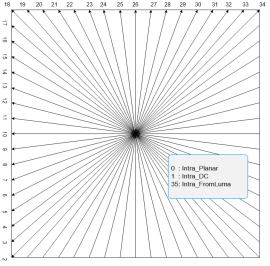
A key to efficient video compression is predicting future video frames on the basis of past ones. This diagram concerns "intra angular prediction."
(Credit: ISO)
UHD also requires a new video-coding standard, known as high-efficiency video coding, or HEVC (aka or H.265).
Although the MIT chip isn't intended for commercial release, its developers believe that the challenge of implementing HEVC algorithms in silicon helps illustrate design principles that could be broadly useful.
Moreover, "because now we have the chip with us, it is now possible for us to figure out ways in which different types of video data actually interact with hardware," says Mehul Tikekar, an MIT graduate student in electrical engineering and computer science and one of the paper's co-authors.
How HEVC works
Like older coding standards, the HEVC standard exploits the fact that in successive frames of video, most of the pixels stay the same. Rather than transmitting entire frames, it's usually enough for broadcasters to transmit just the moving pixels, saving a great deal of bandwidth. The first step in the encoding process is thus to calculate "motion vectors" — mathematical descriptions of the motion of objects in the frame.
On the receiving, end, however, that description will not yield a perfectly faithful image, as the orientation of a moving object and the way it's illuminated can change as it moves. So the next step is to add a little extra information to correct motion estimates that are based solely on the vectors. Finally, to save even more bandwidth, the motion vectors and the corrective information are run through a standard data-compression algorithm, and the results are sent to the receiver.
The new chip performs this process in reverse. It was designed by researchers in the lab of Anantha Chandrakasan, the Joseph F. and Nancy P. Keithley Professor of Electrical Engineering and head of the MIT Department of Electrical Engineering and Computer Science.
The chip's first trick for increasing efficiency is to "pipeline" the decoding process: a chunk of data is decompressed and passed to a motion-compensation circuit, but as soon as the motion compensation begins, the decompression circuit takes in the next chunk of data. After motion compensation is complete, the data passes to a circuit that applies the corrective data and, finally, to a filtering circuit that smooths out whatever rough edges remain.
Fine-tuning
Pipelining is fairly standard in most video chips, but the MIT researchers developed a couple of other tricks to further improve efficiency. The application of the corrective data, for instance, is a single calculation known as matrix multiplication. A matrix is just a big grid of numbers; in matrix multiplication, numbers in the rows of one matrix are multiplied by numbers in the columns of another, and the results are added together to produce entries in a new matrix.
"We observed that the matrix has some patterns in it," Tikekar explains. In the new standard, a 32-by-32 matrix, representing a 32-by-32 block of pixels, is multiplied by another 32-by-32 matrix, containing corrective information. In principle, the corrective matrix could contain 1,024 different values. But the MIT researchers observed that, in practice, "there are only 32 unique numbers," Tikekar says. "So we can efficiently implement one of these [multiplications] and then use the same hardware to do the rest."
Similarly, Chiraag Juvekar, another graduate student in Chandrakasan's group, developed a more efficient way to store video data in memory. The "naive way," he explains, would be to store the values of each row of pixels at successive memory addresses. In that scheme, the values of pixels that are next to each other in a row would also be adjacent in memory, but the value of the pixels below them would be far away.
In video decoding, however, "it is highly likely that if you need the pixel on top, you also need the pixel right below it," Juvekar says. "So we optimize the data into small square blocks that are stored together. When you access something from memory, you not only get the pixels on the right and left, but you also get the pixels on the top and bottom in the same request."
Chandrakasan's group specializes in low-power devices, and in ongoing work, the researchers are trying to reduce the power consumption of the chip even further, to prolong the battery life of quad-HD cell phones or tablet computers.
One design modification they plan to investigate, Tikekar says, is the use of several smaller decoding pipelines that work in parallel. Reducing the computational demands on each group of circuits would also reduce the chip's operating voltage.
Email ThisBlogThis!Share to XShare to FacebookShare to Pinterest
Posted in 4K, H.265, HEVC, Quad HD, UHD | No comments
Newer Post Older Post Home

0 comments:

Post a Comment

Subscribe to: Post Comments (Atom)

Popular Posts

  • Russia’s First Smartphone Goes on Sale - NYTimes.com
    http://mobile.nytimes.com/2013/12/05/business/international/russias-first-smartphone-goes-on-sale.html
  • Bids come in low for Kodak's digital-imaging patents - CNET Mobile
    http://m.cnet.com/news/bids-come-in-low-for-kodaks-digital-imaging-patents/57487868
  • HBO GO App Updated With Support for Google Chromecast
    http://appscout.pcmag.com/apple-ios-iphone-ipad-ipod/318208-hbo-go-app-updated-with-support-for-google-chromecast
  • Fwd: HD USB Endoscope cameras
    ---------- Forwarded message ---------- From: "Osca Rick" < atazsales3@gmail.com > Date: Sep 10, 2012 8:10 AM Subject: HD US...
  • Source: Instagram Will Get Video On June 20 - TechCrunch
    http://m.techcrunch.com/2013/06/17/source-instagram-will-get-video-on-june-20/
  • Fwd: 3G HDSDI better video conference
    ---------- Forwarded message ---------- From: Date: Sunday, September 8, 2013 Subject: Fwd: 3G HDSDI better video conference To: andycheung...
  • Apple iGlasses Coming Soon? New Patent Reveals Rival To Google's Project Glass
    http://www.ibtimes.com/articles/360019/20120705/apple-iglasses-patent-google-project-glass-glasses.htm  Apple was reportedly  granted a pate...
  • Android 4.0-based HDMI dongle, Kickstarts the Pocket TV
    http://www.kickstarter.com/projects/484889112/the-pocket-tv-makes-any-tv-a-smart-tv The Pocket TV: Makes any TV a Smart TV A Technology proj...
  • 88% reduction in complaints by requiring cameras.
    In Rialto California police officers were required to wear a camera in order to document their interactions with civilians. In these areas, ...
  • Quiet Victories Won In the Loudness Wars - Slashdot
    http://entertainment.slashdot.org/story/12/06/26/0022244/quiet-victories-won-in-the-loudness-wars Stowie101 writes with a few pieces from an...

Categories

  • 3D Camera
  • 3D Display
  • 3D Glasses
  • 3D Streaming
  • 3DTV
  • 4K
  • Akamai
  • alternative
  • android
  • android application
  • android firmware
  • Anybots
  • apple
  • Apple TV
  • ATT U-Verse
  • audio
  • Augmented Reality
  • autostereoscopic
  • Avegant
  • BrightSign
  • Broadcast
  • Cable
  • camera
  • camera array
  • cbs
  • CCD
  • cctv
  • CDN
  • Chrome
  • Chromecast
  • Cisco
  • cloud
  • codec
  • comcast
  • commercial
  • Connected TV
  • copyright
  • Cox
  • digital billboards
  • Digital Cinema
  • Digital Millennium Copyright Act
  • Digital Signage
  • Displayport
  • Displays
  • dongle
  • epaper
  • fcc
  • Flash
  • FM
  • formats
  • future
  • Gesture
  • getUserMedia
  • google
  • Google Glass
  • google TV
  • H.264
  • H.265
  • HBO
  • HDMI
  • head tracking
  • HEVC
  • History
  • hmd
  • html5
  • Interesting
  • IP Cameras
  • Jabber
  • joke
  • Kinect
  • kiosk
  • LAW
  • LCD
  • lens
  • LG
  • linux
  • Lytro
  • Marshall Mcluhan
  • matchmoving
  • Matrox
  • memetics
  • MHL
  • Microsoft
  • mobile
  • Mozilla
  • mpeg
  • MPEG-LA
  • multitouch
  • multiview
  • MVC
  • Netflix
  • Netgear
  • Nintendo
  • NVIDIA
  • Oculus VR
  • OmniVision
  • ON2. vp8
  • P2P
  • photography
  • Polycom
  • Quad HD
  • QUIC
  • quote
  • Satellite
  • society
  • software
  • spectrum
  • STB
  • storage
  • Streaming
  • surveillance
  • telepresence
  • Television
  • Time Warner
  • touch screen
  • UDP
  • UHD
  • USB
  • VC
  • Video Ads
  • video conference
  • video editor
  • video player
  • VideoTechnology
  • viral video
  • virtual reality
  • virtual retinal display
  • vp9
  • web apps
  • WebM
  • Wifi
  • windows application
  • windows phone
  • Xbox
  • XMPP
  • youtube

Blog Archive

  • ▼  2013 (292)
    • ►  December (2)
    • ►  November (32)
    • ►  October (26)
    • ►  September (34)
    • ►  August (26)
    • ►  July (42)
    • ►  June (22)
    • ►  May (45)
    • ►  April (11)
    • ►  March (18)
    • ▼  February (16)
      • Fwd: TokBox News: February 2013
      • Fwd: Optrix XD5 - Toughest iPhone 5 action video c...
      • Fwd: Nu Horizons Electronics Portal - Your Gateway...
      • Recent purchase by Yahoo is a video conference bro...
      • New Worldwide Movement To Destroy As Many Security...
      • New Imaging Device That Is Flexible, Flat, and Tra...
      • Canons mixed reality headset
      • 1.8 gigapixel ARGUS-IS. World's highest resolution...
      • Google Is Working On A UDP Replacement Called QUIC
      • MIT researchers build ultrahigh-definition Quad HD...
      • Video phone Arduino shield
      • Here's Why So Many Russians Have Dash Cams
      • Fwd: Intel's Streaming TV Ambitions Are Real, And ...
      • Fwd: U.S. judge rejects 13 Google-Motorola patent ...
      • ComputerVision & Graphics software
      • Streaming video latency on GoPro Hero3 Black.
    • ►  January (18)
  • ►  2012 (213)
    • ►  December (5)
    • ►  November (19)
    • ►  October (14)
    • ►  September (16)
    • ►  August (29)
    • ►  July (43)
    • ►  June (87)
Powered by Blogger.

About Me

Unknown
View my complete profile