



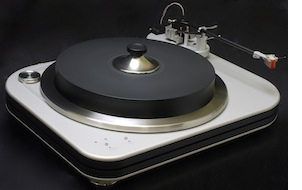
 BERKELEY, CALIFORNIA, December 3, 2013 - At CES 2014 Spiral Groove will be exhibiting its ultrahigh-end SG1.1 turntable, which has received a 2013 Products of the Year award from Stereophile magazine. Named one of two Analog Components of 2013 by the publication, the SG1.1 turntable and companion Centroid tonearm are designed to deliver ultimate-quality record playback.


Wednesday, 4 December 2013
Tuesday, 3 December 2013
---------- Forwarded message ----------
Date: Tuesday, December 3, 2013
Subject: Press Release: Spiral Groove SG 1.1 Turntable Wins Stereophile Award, Will Be Exhibited at CES 2014
| ||||
| |
Saturday, 30 November 2013
Thursday, 28 November 2013
Monday, 25 November 2013
Sunday, 24 November 2013
Friday, 22 November 2013
Thursday, 21 November 2013
---------- Forwarded message ----------
From: TokBox Inc. <marketing@tokbox.com>
Date: Thu, Nov 21, 2013 at 11:34 AM
Subject: Exciting OpenTok platform advancements
To: John.sokol
From: TokBox Inc. <marketing@tokbox.com>
Date: Thu, Nov 21, 2013 at 11:34 AM
Subject: Exciting OpenTok platform advancements
To: John.sokol
|
  |      | |||
| 115 Stillman Ave, San Francisco, CA 94107 |
| Business: bizdev@tokbox.com | Support: tokbox.com/opentok/support | Feedback: OpenTok Survey |
Wednesday, 20 November 2013
We place this on the Video Technology Blog, because it is:
an excellent essay by Deirdre Moen, wife of an excellent friend.
Deirdre is very nice person too.
http://deirdre.net/why-television-pricing-is-broken/
or
http://dsmoen.livejournal.com/480376.html
(Same article in different places, each with a comment thread.)
Related piece:
http://deirdre.net/getting-rid-of-cable/
or
http://dsmoen.livejournal.com/398144.html
an excellent essay by Deirdre Moen, wife of an excellent friend.
Deirdre is very nice person too.
http://deirdre.net/why-television-pricing-is-broken/
or
http://dsmoen.livejournal.com/480376.html
(Same article in different places, each with a comment thread.)
Related piece:
http://deirdre.net/getting-rid-of-cable/
or
http://dsmoen.livejournal.com/398144.html
Tuesday, 19 November 2013
Begin forwarded message:
From: "VITEC"
Date: November 19, 2013, 10:05:13 AM PST
Subject: VITEC's HDM850+ for HEVC decoding over SDI HDMI - Available Now
To view this email as a web page, go here.
HEVC codec is on its way, be ready! Today, with the Stradis HDM850+ decoder board, it is possible to decode and display HEVC / H.265 clips or stream over SDI / HDMI.
HDM850+ is fully featured for professional broadcast applications such as content distribution, station/news automation, and quality control or simply for rendering/testing the latest video standards. Featuring unique frame accurate playback and compatible with HEVC, H.264 and MPEG-2 video standards (up to 4:2:2, 10 bits), HDM850+ is the most advanced and versatile decoder card available on the market.
HDM850+ is a PCIe based decoder for use by end users as well as integrators (SDK available). It decodes and displays video up to 1080p60 over 3G-SDI or HDMI in a standard PC platform.
Highlights of the HDM850+ broadcast decoder card
- 3G-SDI and HDMI outputs up to 1080p60
- HD/SD HEVC decode (compliant to HM reference decoder)
- HD/SD H.264 & MPEG-2 - 4:2:2 & 4:2:0
- Unique seamless frame accurate playback
- Hardware scaler from any to any resolution
- Genlock Input, RS-422 control, Full frame OSD
- Powerful end user application
- Livewire & Stradis SDK for integrators
- PCIe (4 lanes), multiboard support
Availability
Shipping Now - HDM850+ and HDM850 firmware upgrade are available now through the VITEC worldwide dealer network.
For more information on the Stradis HDM850+ or other VITEC products, visit www.vitecmm.com.

FOLLOW US:

This email was sent by: VITEC
931 Benecia Avenue Sunnyvale, CA 94085 United States
Monday, 18 November 2013
Bjork Explaining Television Is Everything You'd Imagine Bjork Explaining Television to Be
"This is what an Icelandic poet told me. And I became so scared to television that I always got headaches when I watched it. Then, later on, when I got my Danish book on television, I stopped being afraid because I read the truth, the scientifical truth and it was much better."
Björk.
An overview of the IEEE 802.11af or White-Fi proposal for Wi-Fi using the TV White spaces using cognitive radio technology.
White-fi is a term being used to describe the use of a Wi-Fi technology within the TV unused spectrum, or TV white space. The IEEE 802.11af working group has been set up to define a standard to implement this.
With a number of administrations around the globe taking a more flexible approach to spectrum allocations, the idea of low power systems that are able to work within portions of spectrum that may need to be kept clear of high power transmitters to ensure coverage areas do not overlap is being seriously investigated.
When using systems like white-fi, IEEE 802.11af that use TV white space, the overall system must not cause interference to the primary users. With processing technology developing further, this is now becoming more of a possibility.
Benefits of IEEE 802.11af, White-Fi
There are many benefits for a system such as IEEE 802.11af from using TV white space. While the exact nature of the IEEE 802.11af system has not been fully defined, it is still possible to see many of the benefits that can be gained:
- Propagation characteristics: In view of the fact that the 802.11af white-fi system operating the TV white spaces would use frequencies below 1 GHz, this would allow for greater distances to be achieved. Current Wi-Fi systems use frequencies in the ISM bands - the lowest band is 2.4 GHz and here signals are easily absorbed.
- Additional bandwidth: One of the advantages of using TV white space is that additional otherwise unused frequencies can be accessed. However, it will be necessary to aggregate several TV channels to provide the bandwidths that Wi-Fi uses on 2.4 and 5.6 GHz, to achieve the required data throughput rates. It is possible that vacant channels in any given area will vary widely in frequency and this presents some challenges in managing the data sharing across the different channels, although this has been successfully achieved in technologies such as LTE.
Looking at these benefits, it is believed that the White-Fi system offers sufficient advantages to enable development to be undertaken.
IEEE 802.1af white-fi technologies
In order for white-fi 802.11af to be able to operate, it is necessary to ensure that the system does not create any undue interference with existing television transmissions. To achieve this there are a number of technologies and rules that may be utilized.
- Cognitive radio: One way in which a white-fi system would be able to operate is to use cognitive radio technology;
Note on Cognitive Radio:
With pressure on radio spectrum increasing all the time, it is necessary to utilize the available spectrum as efficiently as possible. One method of helping to achieve this is utilize radio technology that is able to sense the environment and configure itself accordingly - Cognitive Radio. The technology is heavily dependent upon Software Defined Radio technology as the radio needs to be configurable according to the prevailing radio environment.
Click on the link for further information about Cognitive Radio technology
Using this technology, it will be possible for the white-fi, IEEE 802.11af system to detect transmissions and move to alternative channels. - Geographic sensing: Another method that is favoured by many is geographic sensing. Although details are not fully defined, having a geographic database and a knowledge of what channels are available there is another way of allowing the system to avoid used channels.
Salient features
The table below gives a summary of the salient features of 802.11af.
| 802.11AF CHARACTERISTIC | DESCRIPTION |
|---|---|
| Operating frequency range | 470 - 710MHz |
| Channel bandwidth | 6MHz |
| Transmission power | 20dBm |
| Modulation format | BPSK |
| Antenna gain | 0dBi |
The proposal for the implementation of White-Fi si sill in its draft or development stages. However it provides an effective way or accessing more radio spectrum in an area where available bandwidth is at a premium, and utilising the resource more effectively.
Sunday, 17 November 2013
Saturday, 16 November 2013
Friday, 15 November 2013
Sunday, 10 November 2013
Saturday, 9 November 2013
Wednesday, 6 November 2013
Tuesday, 5 November 2013
Monday, 4 November 2013
<iframe src="//player.vimeo.com/video/76521918" width="500" height="281" webkitallowfullscreen mozallowfullscreen allowfullscreen></iframe>
Sunday, 3 November 2013
Saturday, 2 November 2013
Friday, 1 November 2013
videos demonstrating the same concept:
This demonstration is 100% real. It's relatively simple to create your own.
Check out some extra footage here:
This video shows you how to create a secret LCD monitor.
From YouTube description:
The results are amazing. If you are going to try and make your own, there are a few things to keep in mind. First, I would recommed using a monitor that you don't care about. I bought mine from a pawn shop for $20 dollars. Once you remove the polarized layer, you've pretty much made the monitor useless as to normal use. If you are good with repairs and that sort of thing, I'm sure you could buy a replacement filter to fix the monitor. So basically, just make sure you are ok with modifying whatever monitor you've chosen to use for this project. Once you have your monitor you need to remove the top layer, which is the polarized layer. It helps to remove the plastic frame from the front but it's not 100% necessary. Once you remove the plastic front, use a hobby knife to cut on the edge around the whole monitor. Press hard enough to make the cut but don't press too hard. That's once thing to keep in mind during this whole process is that you can completely destroy the monitor by damaging the actual LCD part of the screen. Once you make the 4 cuts, then pick a corner to start peeling the polarized layer. I used a hobby knife to "dig" under the layer so I could get a big enough piece to grab onto. Now, every monitor is different so you may experience this part a little different than the next person. You want to peel slowly to try and get the biggest pieces possible and also not to put too much force on the screen. This part could take several minutes to get all of the polarized layer off. Most LCD monitors have an antiglare layer "attached" to the polarized layer and both of those layers are glued so the hard surface of the LCD. So you may see these extra layers as you are removing them. If you're lucky you will be able to remove all 3 layers by just pulling it off. But it's likely that some glue will be left over. It's also possible that you will lift the polarized and antiglare layer but leave most of the glue. If you look closely in my video, you can see a few spots where the contrast is different. These are spots where the glue came off. If there are a lot of glue spots and it bothers you, it is possible to remove the glue by using paint thinner. But you have to be very careful. If you use the paint thinner, apply it to the glue spots and use a piece of plastic to gently scrape it off. Don't press too hard or you will destroy the monitor. Overall, I would recommend to stay away from the paint thinner and just live with the glue spots.
Next you want to grab some glasses. I used a pair of the 3D glasses you get at the cinema. I never throw them in the recycle bin :). Anyway, you can open these glasses up and remove the "lenses".
I ordered 2 - 6" X 6" sheets of polarized filters from a popular online science store. I traced the shape of the area where the lenses on the polarized sheets. I cut them out and placed them inside the frames. Before you cut the shape, make sure to note the proper angle of the polarized sheet with the monitor. I had to turn my sheet 45 degrees to get the correct angle. So when I traced the lens shape on the sheet, I turned the sheet 45 degrees and cut them. (In the video the sheet wasnt turned 45 degrees, but that was just a video mistake)
So now you're ready for action. If you hook your monitor up to a computer and put on your glasses you should be able to see the screen just as normal. Anyone standing behind you will only be able to see a blank monitor. If you move far to the sides you can see a little bit of a negative image on the screen, but it's still very hard to make out.
Monday, 28 October 2013
http://variety.com/2013/biz/news/media-biz-profitable-possibilities-coming-via-new-platforms-1200706757/
Challenges abound in the future of the media business. But then again, so do the opportunities
RELATED STORIES


The next 10 years should be the greatest time in the history of the entertainment business.
The global middle class is growing astronomically fast. It may not be growing in the U.S., but it is growing in the rest of the world: Research shows that when people leave poverty and have discretionary income, they spend on entertainment. In addition, the broadband Internet is growing just as fast as the new middle-class population, reaching 3 billion users in the next five years.
But the problem is that the revenues of media and entertainment firms are barely growing above the rate of inflation. Production and marketing costs are climbing. There are signposts of trouble ahead; if we're smart, we won't put our heads in the sand.
Look at what happened at the box office this summer. For the first time, total revenues were no greater than total budgets for movies costing more than $75 million. It's not a good situation.
In the world of television, you have all sorts of disruptive technologies brought to you by Barry Diller (Aereo) and Charlie Ergen (the Hopper) meant to mess with your businesses.
Analyst Craig Moffett, who has been the greatest champion on the cable and satellite TV businesses, finally admitted cord cutting isn't an urban myth anymore. Primetime TV ratings have fallen 50% since 2002.
In home entertainment, the revenue generated from streaming is never going to equal the amount of money studios receive from selling DVDs atWalmart.
The common wisdom about the videogame sector is that it has avoided the problems of other entertainment businesses. But sales for all major platforms are falling. You might say they're all just going to mobile gaming, but Zynga is not a great business either.
The music industry is a total disaster. Streaming has never replaced what the CD did, and newspaper ad revenues have fallen off a cliff. In the month of January, there were 465 million IP addresses accessing pirated material.
All in all, the return on assets of media and entertainment companies is falling way below the rest of the economy. But all these signposts of disruption can also be read as signposts of opportunity.
Note all of the studios that are financing content: YouTube, Netflix, Hulu, Microsoft and Amazon. These platforms are allowing new forms of content to be sold.
There's also all new sorts of funding. Consider what Warner Bros. is doing partnering with Kickstarter on the "Veronica Mars" movie. There's also filmmakers accessing money from China and other new regions.
Then there are entirely new computing platforms to consider, like the new virtual-reality headset Oculus Rift that was developed through a Kickstarter campaign. And think of what 3D printing could bring; imagine Warner Bros. allowing a download of the new Batman figure in time for the Superman/Batman movie in 2015.
There's also all of these new distribution platforms coming forth, including those from Intel, Walmart, Target, Flixter and Redbox that are exploring the notion of over-the-top Internet protocol-based distribution in various ways. They may not be brick-and-mortar, but these places will be the new storefronts of tomorrow.
If content is distributed everywhere on an international basis to a market that could grow to 5 billion consumers, getting just 4% of that market is off-the-charts money.
It could be that current production and distribution systems simply are not capturing the possibilities of this new world. What we need to create is an economy where technology is at the service of creativity, content and context.
Jonathan Taplin is director of the Annenberg Innovation Lab at the USC Annenberg School for Communication and Journalism, where he leads the Edison Project for research and executive education dedicated to forming a new media and entertainment ecosystem. This column was adapted from his Sept. 29 speech at the Hollywood IT Society Marketing and Analytics Summit.
Friday, 25 October 2013
Imagine dropping your phone and seeing it bounce rather than break. Research at RMIT University is bringing that day closer.
The research is advancing transparent bendable electronics for use in science fiction-like gadgets - unbreakable rubber-like phones, rollable tablets and even functional clothing.
Researchers from RMIT's Functional Materials and Microsystems research group have developed a new method to transfer electronics with versatile functionality, which are usually made on rigid silicon, onto a flexible surface.
The result of their work was recently published in Nature Publishing Group's Asia Materials, the leading materials science journal for the Asia-Pacific.
The ability of micro and nano-electronic devices to sense, insulate or generate energy is controlled by thin, transparent nanolayers of oxide materials, often much thinner than 1/100th of a human hair.
These oxide materials are brittle and their high processing temperatures - often in excess of 300 degrees celsius - have until now prevented their incorporation in flexible electronic devices.
Lead author, PhD researcher Philipp Gutruf, said the new process developed at RMIT could unleash the potential of fully functional flexible electronics, while providing a new way for the materials to mesh together.
"We have discovered a micro-tectonic effect, where microscale plates of oxide materials slide over each other, like geological plates, to relieve stress and retain electrical conductivity," he said.
"The novel method we have developed overcomes the challenges of incorporating oxide materials in bendable electronic devices, paving the way for bendable consumer electronics and other exciting applications."
Supervisor and co-leader of the research group, Dr Madhu Bhaskaran, said the new approach used two popular materials - transparent conductive indium tin oxide and rubber-like silicone, which is also biocompatible.
"The ability to combine any functional oxide with this biocompatible material creates the potential for biomedical devices to monitor or stimulate nerve cells and organs," she said.
"This is in addition to the immediate potential for consumer electronics applications in flexible displays, solar cells, and energy harvesters."
Mr Gutruf is supported by an Australian Government Endeavour International Postgraduate Research Scholarship.
The research was supported by Australian Post-Doctoral Fellowships from the Australian Research Council to Dr Bhaskaran and Dr Sharath Sriram, co-leader of the research group.
Subscribe to:
Comments (Atom)


